|
 |
|
|
|
| |
Sample
Student and Teacher Work
Chemsense software and activities have been used by hundreds
of California high school students in our five partner high
schools, hundreds of undergraduate students at the Univerisity
of Michigan, about two dozen high school teachers in summer
workshops at Texas A&M and at SRI International, and in
a study at the University of Twente, The Netherlands. Sample
student and teacher work is shown below.
Texas A&M Science
Teaching and Learning Center Teacher Workshops
High school teachers in the Structure
and Properties of Matter and Chemical Reactions: Molecular Visualization
workshop used ChemSense to create animations during the
summers of 2001, 2003, and 2003. The workshops focused on developing
connections between four levels of understanding of chemical
concepts: the macroscopic level, the particle level, the symbolic
level, and the mathematical level.
Sample animations created with ChemSense by Texas teachers:
An
example of dynamic equilibrium (by Hall)
Formation
of CO2 and NO (by Lassy)
Reaction
energy (by Rodgers)
Formation
of NiOH2 (by Brode)
San Leandro High
School
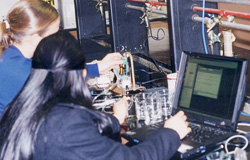 In the winter of 2000 and spring of 2002 and 2003, San
Leandro High School (SLHS) students used ChemSense to
investigate and design experiments around the topic of solubility.
Students created drawings and animations of their predictions
and observations, used PASCO to collect and graph lab data,
and viewed and commented on their peers' work in ChemSense.
In the winter of 2000 and spring of 2002 and 2003, San
Leandro High School (SLHS) students used ChemSense to
investigate and design experiments around the topic of solubility.
Students created drawings and animations of their predictions
and observations, used PASCO to collect and graph lab data,
and viewed and commented on their peers' work in ChemSense.
Sample animations created with ChemSense by SLHS students:
Salt
dissolving in water (Group 8)
Salt
dissolving in water (Group 2)
Miramonte
High School
Students in ten classrooms at Miramonte
High School (MHS) used ChemSense for a variety of activities
during the 2002/2003 school year. For example, students animated
H2O molecules as they changed phase from a solid
to a liquid to a gas, with a graph indicating the temperature
at each point in the animation. From pre- to post-test, students
showed marked improvement in their ability to create detailed
and accurate representations of H2O molecules in
the solid, liquid, and gaseous phases.
Sample animations created with ChemSense by MHS students:
Water
phase change (Group 11)
Water
phase change (Group 12)
Water
phase change (Group 13)
Antioch High
School
Students at Antioch
High School (AHS) used ChemSense for a variety of activities
during the 2002/2003 school year. Activities included the
topics of hybridization, kinetics, and electro chemistry.
Sample animations created with ChemSense by AHS students:
Hybridization
Group 1
Hybridization
Group 2
2H2
+ O2 "Rain dance"
Crystal
Violet Kinetics
Electro
Chemistry
University of
Michigan
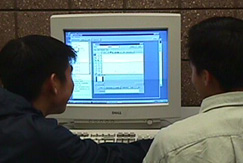 In fall 2000, 2001, 2002, and spring 2003, students in Chem
210 SSG at the University of Michigan (UM) used ChemSense
for a variety of activities. For example, students classified
a subset of given compounds through investigations of bond
strength. Students selected triads of compounds to examine
the structure-reactivity relationship, reviewed their peers'
design proposals, collected lab data, and created static and
animated versions of their predicted reactions in ChemSense.
In fall 2000, 2001, 2002, and spring 2003, students in Chem
210 SSG at the University of Michigan (UM) used ChemSense
for a variety of activities. For example, students classified
a subset of given compounds through investigations of bond
strength. Students selected triads of compounds to examine
the structure-reactivity relationship, reviewed their peers'
design proposals, collected lab data, and created static and
animated versions of their predicted reactions in ChemSense.
Sample animations created with ChemSense by UM students:
Rate
of solvolysis in water of 2-iodo-2-methylpropane
Formation
of Scopadulcic Acid
University of
Twente, The Netherlands
Pre-university students from four schools participated in
a study by J.H. (Han) Vermaat to examine the use of animations
in chemistry education. The processes of melting of ice and
dissolving of salt were investigated, and presented at the
AECT 2003 Annual Conference
as well as the Gordon
Research Conference in Visualization and Science Education.
Sample animation created with ChemSense by Dr. Vermaat:
Melting
ice (1.8 MB, may take awhile to download)
|
|
|
|
 |
|
|
|